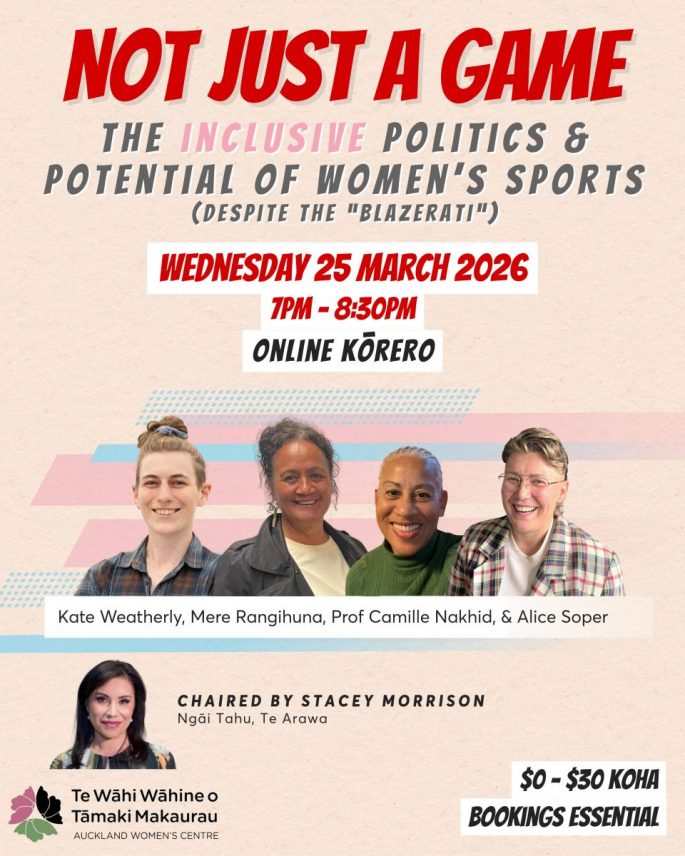
National rugby representatives who are proudly Rainbow, inclusive, waiata-singing… as shown most famously at the 2022 World Cup, this is not a fever dream, but the Black Ferns’ entire way of being. Across multiple sporting codes, women make competition more fierce through inclusivity – and the joyous reverberations are felt beyond the pitch and throughout our communities.
Whether or not you know it, women’s sport affects your life.
But why don’t we hear more about women’s sport, why are coaches mostly men and why doesn’t women’s sport get the funding it deserves? What are the tactics of chauvinist and racist “blazeratti” – administrators and officials – to stop sports’ inclusive feminists? What is the fallout of the transphobic government’s attacks on Ihi Aotearoa Sport NZ’s trans-inclusive guidelines? What part does the media have to play? What’s at stake, what’s next – and why do coaches hog the headlines?
Alice Soper
Women’s sports advocate, journalist & rugby player
“Brilliant and smart… one of the best writers [in the world] on the women’s game” – Scrum Queens
“Human firework” – The Spinoff
We’re in for a treat – nobody else knows and analyses the gender power politics off the pitch, and the brilliant play on it like Alice. A hype woman who makes sense.
“The origins of women’s sport are in protest…” – Alice Soper
Mere Rangihuna (Ngāti Hine, Ngā Puhi, Ngāti Manu, Te Uri-o-Hau)
Aktive Māori Participation Manager and Event Producer of Iwi of Origin. Mere has managed several Performance teams including, Māori Football Aotearoa Senior Mauri team, the Bay of Plenty Volcanix women’s rugby team, AVIS Magic Netball team (Waikato/BOP) and former manager of the Kiwi Ferns women’s league team.
With more than 30 years of high-profile leadership across multiple sporting codes, Mere brings deep experience, sharp insight, and a wealth of stories from the elite and community sport landscapes.
[the athletes]
Kate Weatherly
NZ mountain biking champion 2018 & 2019
Admirable, determined and extraordinary, Kate continues to be a sports inclusion & equity advocate despite receiving death threats as a high-profile trans athlete.
“There are ways we can have these conversations in a respectful and consistent way, and ensure that everyone’s voices are heard.” – Kate Weatherly
Prof Camille Nakhid (MNZM)
Social sciences researcher, AUT
Camille will bring necessary and constructive challenges to the table – Is women’s sport really inclusive – or do we just maintain a “polite” don’t-rock-the-boat silence about racism in women’s sport?
“In Aotearoa, the desire to believe that Indigenous, Brown, and Black female athletes do not face racism aligns with the misleading perception of a racist-free country” – Camille Nakhid